
Blog
How Do I Get Artwork Appraised? A Step-by-Step Guide for First-Time Owners
Getting artwork appraised starts with knowing why you need the report, since insurance, estate, donation, and resale purposes each demand different documentation and standards. This guide walks first-time owners through choosing a qualified appraiser, preparing records, and reading the finished report.
Owning a piece of art you've never had appraised puts you in an unfamiliar spot. You don't know who to call, what they'll need from you, or how to tell a real appraisal from a casual guess at value. The process is more structured than it looks from the outside, and it starts well before anyone examines the piece.
Why the Purpose of the Appraisal Comes First
The single question that shapes everything else is: what will this appraisal be used for? An appraisal prepared for insurance coverage typically states a replacement value (what it would cost to replace the piece with a comparable one at retail), while an appraisal for charitable donation, estate settlement, or divorce generally states fair market value, defined as the price a willing buyer would pay a willing seller when neither is under pressure to act and both have reasonable knowledge of the relevant facts, per the IRS Publication 561 definition.
These aren't interchangeable numbers. A piece insured for its replacement cost might carry a materially different figure than the same piece valued for an estate tax filing or a resale decision. Tell the appraiser the intended use upfront, because it determines the valuation method, the report format, and in some cases which IRS forms come into play. Common reasons owners commission a first appraisal include:
- Insurance coverage, to set an accurate policy limit and support a future claim, as covered in our guide to art appraisal for insurance coverage
- Estate settlement, to establish fair market value for probate or estate tax purposes
- Charitable donation, to substantiate a tax deduction for a gift to a qualified organization
- Resale or consignment, to understand realistic market expectations before listing a piece
- Divorce or equitable distribution, to establish a defensible value for asset division
Appraiser, Auction House, or Dealer: They Are Not the Same Thing
A first-time owner's most common mistake is treating an auction estimate or a dealer's purchase offer as equivalent to an independent appraisal. They aren't, and the difference matters.
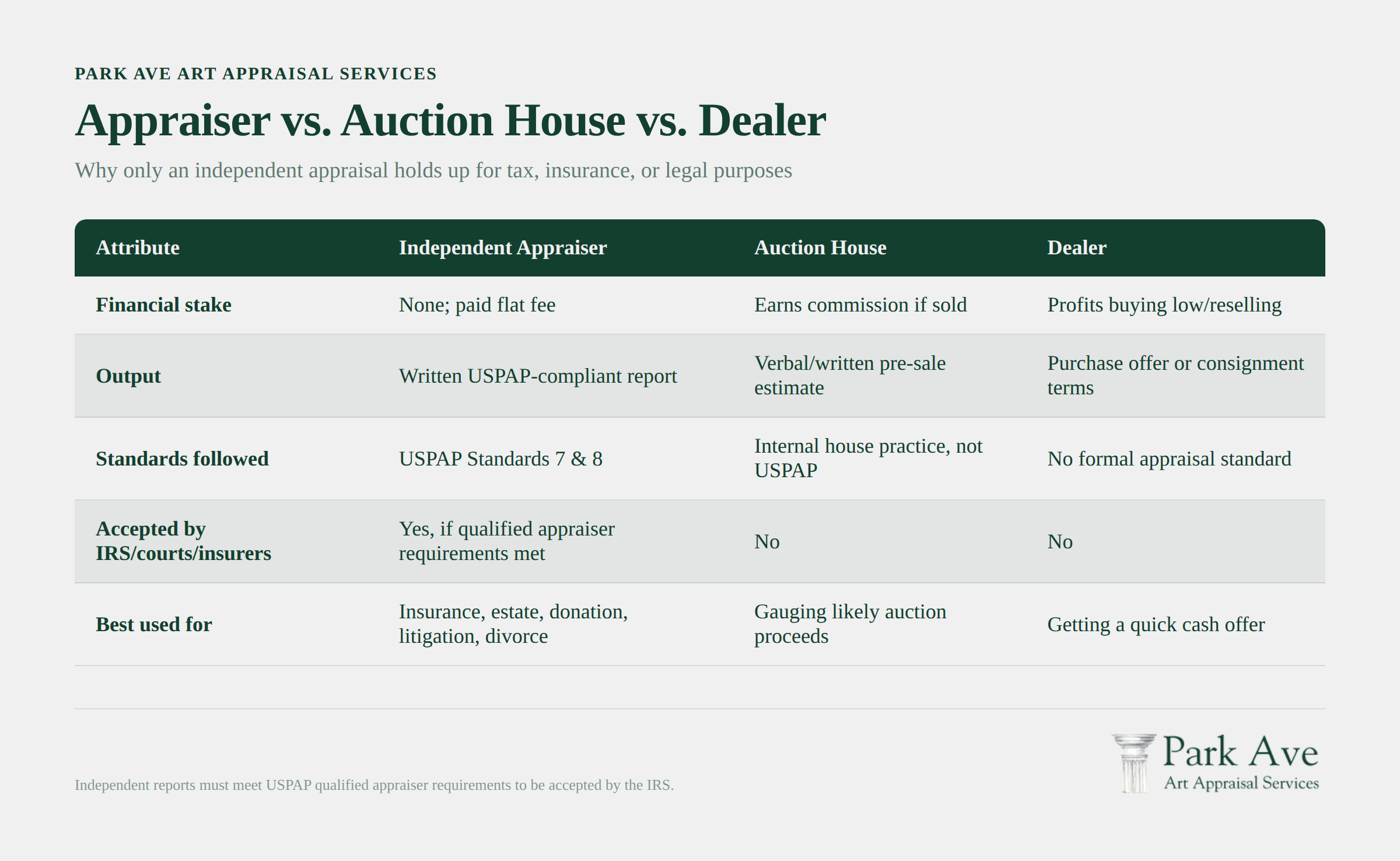
An auction house's pre-sale estimate is a marketing tool designed to attract consignments and bidders; it reflects what the house believes a piece might fetch at that specific sale, not a neutral valuation. A dealer's offer to buy is a negotiating position, shaped by what the dealer can resell the piece for and how much margin they need. Both parties have a direct financial stake in the transaction. An independent appraiser has no ownership interest in the piece and no stake in whether it sells, which is precisely what makes a USPAP-compliant report defensible to the IRS, an insurer, or a court.
| Independent Appraiser | Auction House | Dealer | |
|---|---|---|---|
| Financial stake in the piece | None; paid a flat fee for the report | Earns commission if the piece sells | Profits from buying low or reselling |
| Output | Written, USPAP-compliant valuation report | Verbal or written pre-sale estimate | Purchase offer or consignment terms |
| Standards followed | USPAP Standards 7 and 8 for personal property | Internal house practice, not USPAP | No formal appraisal standard |
| Accepted by IRS, courts, insurers | Yes, when qualified appraiser requirements are met | No | No |
| Best used for | Insurance, estate, donation, litigation, divorce | Gauging likely auction proceeds | Getting a quick cash offer |
If you eventually plan to sell through an auction house or dealer, that's a legitimate next step, just not a substitute for the independent report you need for tax, insurance, or legal purposes.
Choosing a Qualified Appraiser
Look for an appraiser who prepares reports in accordance with USPAP (the Uniform Standards of Professional Appraisal Practice, published by The Appraisal Foundation and updated on a two-year cycle, with the current version effective January 1, 2024). USPAP's personal property standards, Standards 7 and 8, govern how an appraiser develops and reports a valuation for art and similar objects.
Credentials worth checking for include the American Society of Appraisers (ASA), the International Society of Appraisers (ISA), and the Appraisers Association of America (AAA). Guidance from the appraisal profession describes a qualified appraiser as someone who regularly performs appraisals and holds themselves out to the public as an appraiser of the specific type of property being valued, with education and experience matched to that category. A specialist in Old Masters isn't automatically the right fit for a contemporary print collection, and vice versa.
Watch out: No single appraiser holds every credential, and that's normal. What matters is that the appraiser assigned to your piece has demonstrated expertise in that specific category of art and will state their USPAP compliance in writing.
For artwork appraisals, engagements are quoted as a fixed fee once the appraiser scopes the assignment. Fees are driven by the complexity of the piece or collection, the completeness of the records you can provide, and whether the report needs to be IRS-qualified rather than a standard valuation, never by the artwork's market value itself. You can review typical artwork appraisal cost ranges before scheduling.
What to Gather Before the Appraisal Appointment
A well-prepared owner speeds up the process and often gets a stronger, more defensible report. Before the appointment, try to assemble:
- Provenance records: bills of sale, gallery receipts, gift documentation, or any paper trail showing prior ownership
- Prior sales or purchase history: what you paid, when, and from whom
- Exhibition history: any record the piece was shown publicly, which can support both authenticity and value
- Condition information: existing conservation reports, restoration records, or notes on damage
- Photographs: clear images of the front, back, signature, and any inscriptions or condition issues
You don't need a complete file to move forward. Gaps are common, especially with inherited pieces, and an experienced appraiser will factor missing information into the report's limiting conditions rather than refusing the assignment.
What Happens During the Appraisal
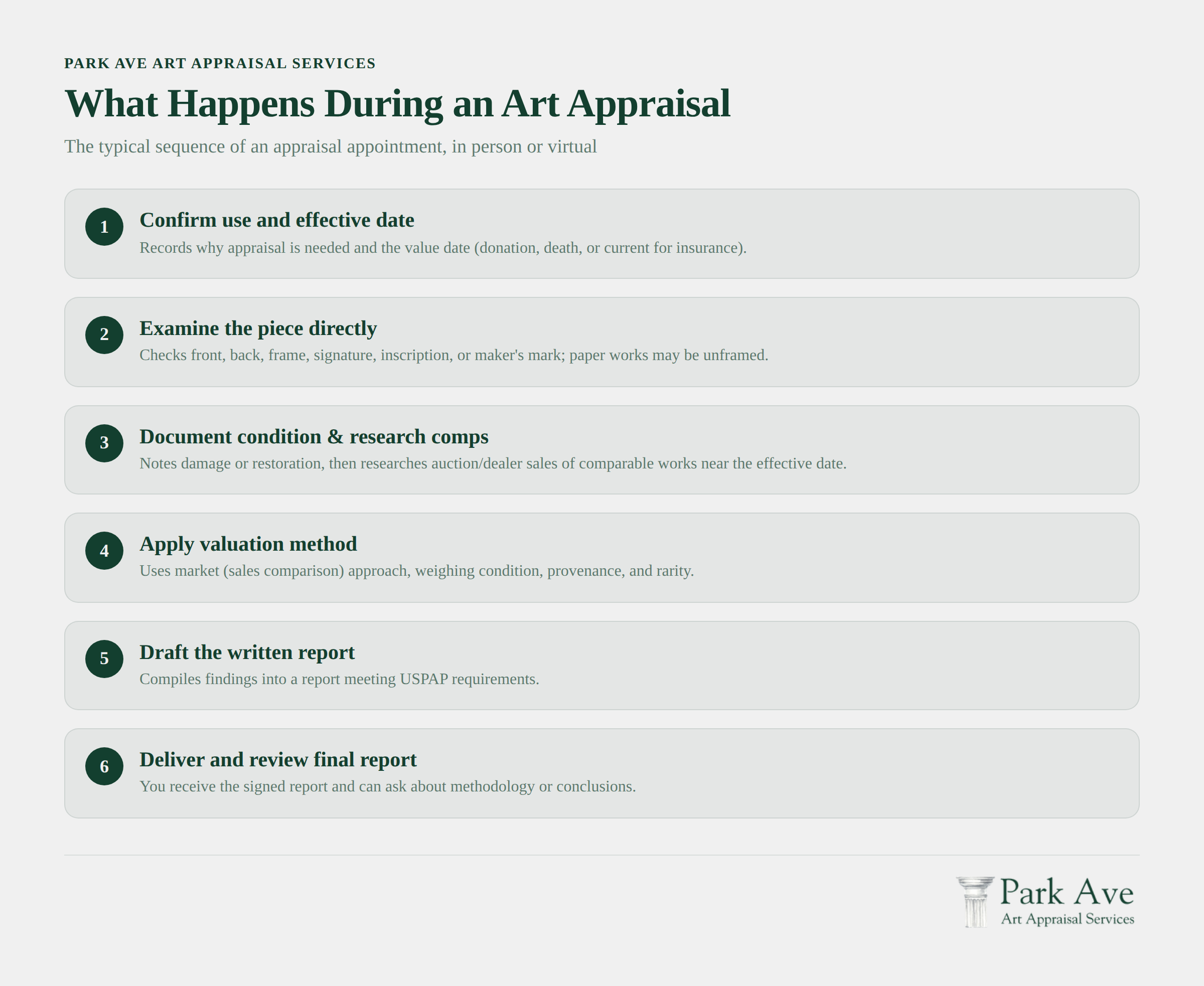
The appointment itself follows a fairly consistent sequence, whether it happens in person or through a virtual inspection.
- Confirm the intended use and effective date. The appraiser records why the appraisal is needed and the date the value should reflect (date of donation, date of death, current date for insurance).
- Examine the piece directly. This includes the front and back, the frame if present, and any signature, inscription, or maker's mark. Works on paper may need to come out of framing for a full examination.
- Document condition. The appraiser notes any damage, restoration, or conservation concerns that affect value.
- Research comparable sales. The appraiser researches auction records and dealer sales of comparable works by the same artist or in the same category, ideally close to the effective date.
- Apply the appropriate valuation method. Most art appraisals rely on a market (sales comparison) approach, weighing the comparables against the specific piece's condition, provenance, and rarity.
- Draft the written report. The appraiser compiles findings into a report that meets USPAP's reporting requirements.
- Deliver and review the final report. You receive the signed report and can ask questions about the methodology or conclusions.
Reading Your Appraisal Report
A compliant report should let someone unfamiliar with the piece understand exactly how the appraiser reached their number. At minimum, expect to see:
- A full description of the object: artist or maker, title, medium, dimensions, date, and any identifying marks
- The effective date of valuation and the type of value used (fair market value or replacement value, stated explicitly)
- An intended use and intended user statement, naming who the report is for and what it should be used to support
- The valuation methodology, typically comparable sales, with enough detail to show which sales were considered and why
- The appraiser's signed certification, including their qualifications and a statement of USPAP compliance
If any of these elements are missing, ask why. A report that skips the methodology section or omits an intended use statement is harder to defend to an insurer, the IRS, or a court, and may need to be redone.
IRS Rules for Donation Appraisals
If the appraisal supports a charitable deduction, the IRS applies specific dollar thresholds that determine what you must file and attach.
- Under $500: no appraisal or Form 8283 required, though you should still keep records of value.
- $500 to $5,000: you must file Form 8283, Section A, but a formal appraisal generally isn't required.
- $5,000 or more: you must obtain a qualified appraisal from a qualified appraiser and complete Form 8283, Section B, with signatures from both the appraiser and the donee organization.
- $20,000 or more: a complete, signed copy of the appraisal must be attached to your tax return, and photo documentation of the piece may be required upon request.
- $500,000 or more (any donated property): the qualified appraisal itself must be attached to the return.
For art appraised at $50,000 or more, donors can request an IRS Statement of Value before filing, a pre-review of the appraised value that can then be relied on for reporting purposes.
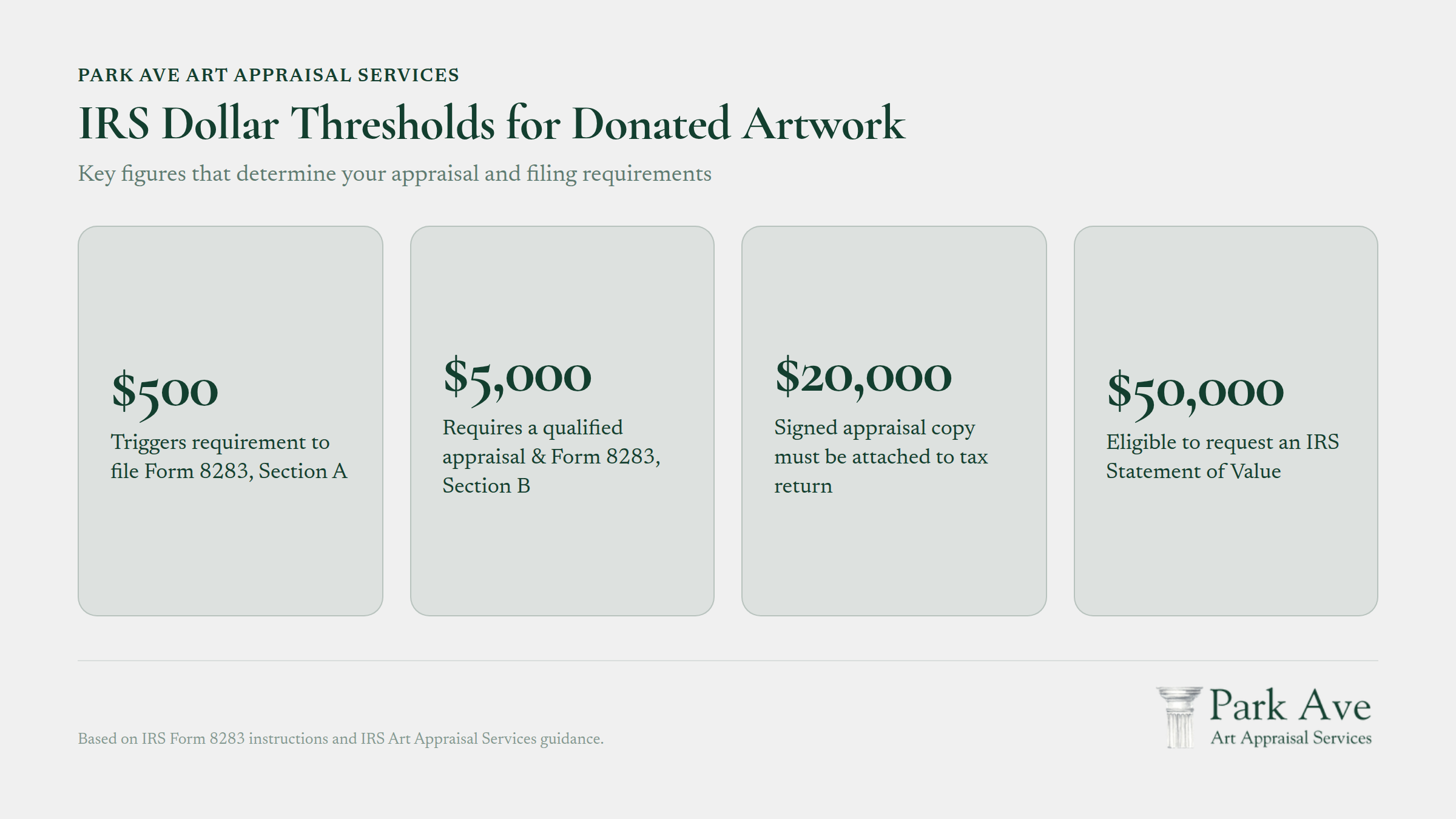
Key takeaway: These thresholds apply per item or per group of similar items donated in the same tax year, so smaller donations can still trigger the qualified appraisal requirement once they're aggregated. Getting the paperwork wrong doesn't just delay a refund; it can result in a denied deduction.
Getting Started With Confidence
A first artwork appraisal feels like a lot of unfamiliar process at once: choosing the right professional, gathering records you may not have thought to keep, and learning to read a report full of technical language. Once you know the purpose driving the assignment, the rest of the steps follow logically, and a qualified appraiser will guide you through the documentation gaps rather than leave you guessing.
Whether you need a report for insurance, an estate, a donation, or a sale, working with a credentialed appraiser who states their USPAP compliance in writing is the difference between a number you can act on and one that falls apart under scrutiny. If you're ready to move forward, request an appraisal and describe the intended use so the assignment can be scoped correctly from the start.
This article is provided for general informational purposes only and does not constitute legal, tax, or financial advice. Readers should consult a qualified attorney or CPA regarding their specific circumstances.